


The Future of Egg Production in Ukraine: Lecturers of the Faculty of Animal Husbandry and Aquatic Bioresources Join a Professional Webinar

Ukrainian poultry farming is currently undergoing a significant stage of transformation. Egg producers face the need not only to maintain production stability but also to adapt poultry housing technologies to new animal welfare requirements and the gradual alignment of Ukrainian legislation with European standards.
As is well known, Order No. 224 of the Ministry of Development of Economy, Trade and Agriculture of Ukraine dated February 8, 2021, "On Approval of Requirements for the Welfare of Farm Animals During Their Keeping," approved the welfare requirements for laying hens in accordance with Council Directive 1999/74/EC of July 19, 1999. These requirements entered into force on January 1, 2026.
Professional events that enable poultry farmers to receive up-to-date information directly from leading experts and equipment manufacturers are becoming particularly relevant. Therefore, on September 3, an online webinar titled "The Future of Egg Production in Ukraine" was held, organized by Vencomatic Group, one of the world's leading manufacturers of technological solutions for poultry farming and alternative housing systems for laying hens, with the participation of the Poultry Breeders Union of Ukraine association.
During the webinar, participants had the opportunity to explore modern approaches to organizing table egg production, alternative housing systems for laying hens, technological solutions, and prospects for adapting Ukrainian enterprises to the new requirements.
In particular, Serhii Karpenko, Director of the Poultry Breeders Union of Ukraine association, outlined the challenges currently faced by domestic table egg producers following the entry into force on January 1, 2026, of the "Requirements for the Welfare of Farm Animals During Their Keeping" in compliance with Council Directive 1999/74/EC.

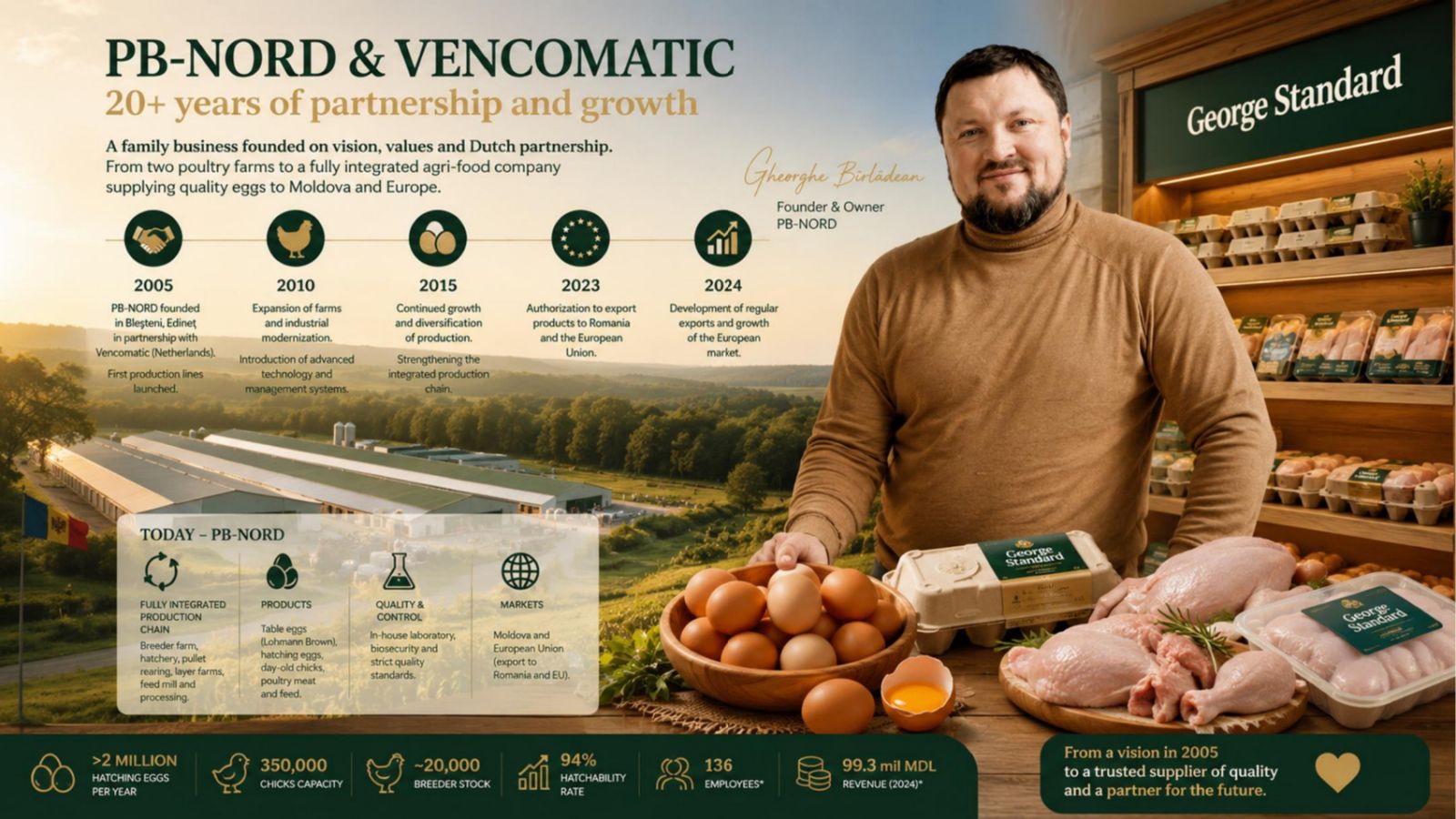
Heorhii Berladian, Founder and Owner of PB Nord, shared his practical experience in modern chicken egg production in Moldova using aviary housing systems for both pullets and laying hens.

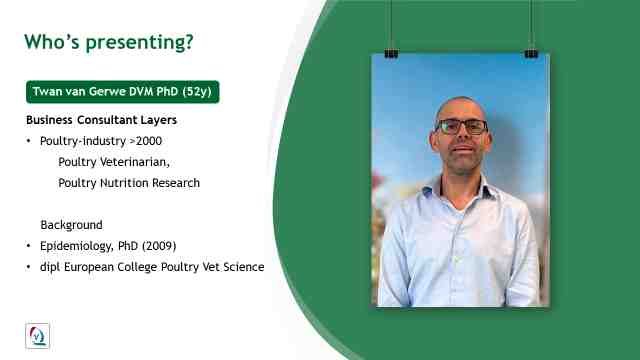
Twan van Gerwe, Layer Business Consultant at Vencomatic Group, spoke about the opportunities for table egg production under cage-free housing systems and what this transition means in practice.
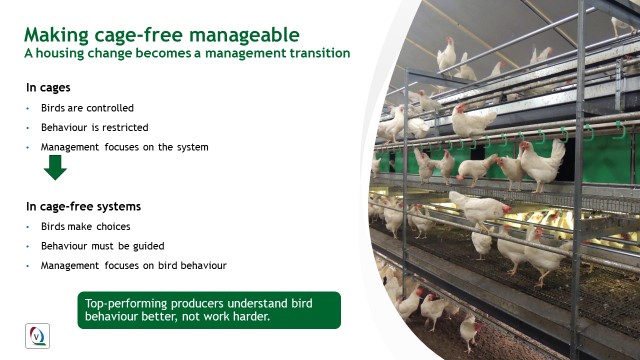
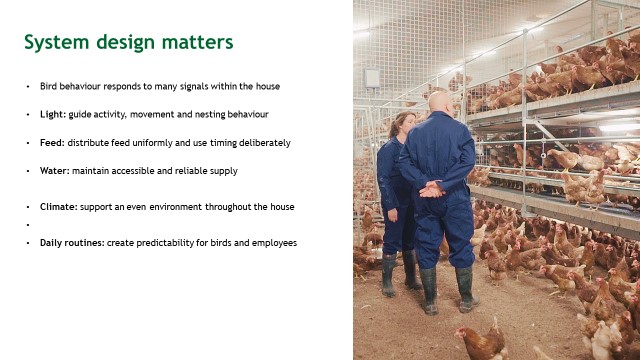
He emphasized that cage-free housing for laying hens should be viewed not only as a component of ensuring an appropriate level of poultry welfare, but also as a transition to a new model of organizing and managing production processes. The operational efficiency of a cage-free system is largely determined by proper bird preparation, sound engineering design of the technological system, and the adaptation of management approaches to new production conditions. When these factors are comprehensively addressed, stability and predictability of production performance are ensured, effective control over the number of floor eggs is achieved, and investments in production modernization create additional opportunities to adapt to future changes in the market environment. It is essential to stay one step ahead of market demand. In Europe, retail chains are increasingly demanding table eggs from cage-free hens, a production method that consumers increasingly associate with higher animal welfare standards. For Ukrainian poultry farmers considering future exports to Europe—and operating within the broader context of Ukraine's further integration into the European market—the technological retrofitting of poultry houses for laying hens is becoming increasingly important.
The retail market for chicken eggs in EU countries is gradually phasing out Code 3, which designates eggs produced by hens kept in battery cages. This market shift is already clearly visible in European retail egg sales, with Code 3 eggs indicated in red on the chart.
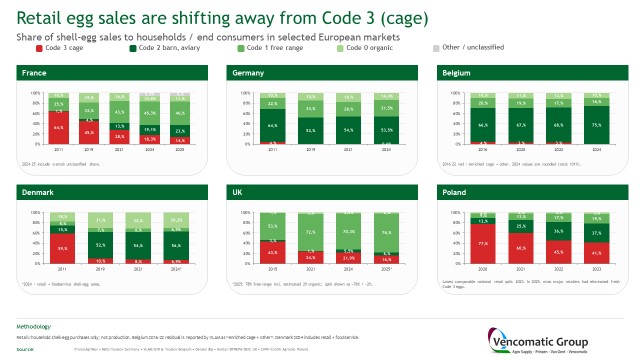
Despite differences in the pace of transforming production systems across various countries, the overall trend is a gradual decrease in the retail share of eggs from caged hens.
Tetiana Alifanova, Regional Sales Manager at Vencomatic Group, connected the innovative ideas and practical experience of poultry farmers in Moldova and the EU with the Ukrainian poultry sector.

Overall, the webinar offered practical insights into future poultry housing conditions, day-to-day production management, and preparing businesses for shifting market expectations.
Such events serve as an important platform for exchanging experience among producers, researchers, academic faculty, and representatives of technology companies. Successful adaptation of Ukrainian poultry farming to new conditions requires not only regulatory changes, but also modern technologies, professional expertise, and well-trained specialists.
Lecturers of the Department of Animal Husbandry Technologies also actively participate in professional industry events. The acquired knowledge and insights into modern technological solutions are integrated into the educational process when teaching poultry farming courses. This is particularly vital for future specialists, as students must be familiar not only with traditional poultry production technologies, but also understand how the modern industry is evolving, what requirements are placed on production, and which technological solutions ensure production efficiency alongside an appropriate level of animal welfare.
The future of Ukrainian poultry farming lies in modern technologies, professional knowledge, a responsible attitude toward bird welfare, and the industry's readiness for European standards.